
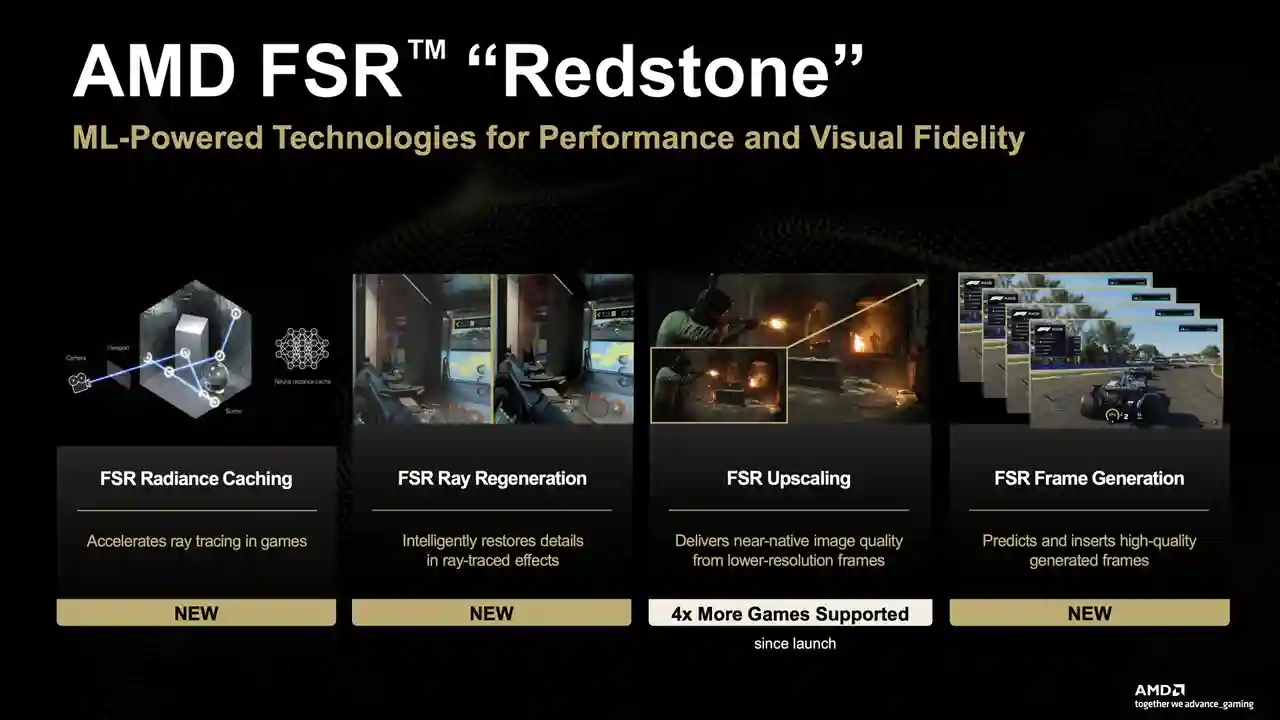
AMD unleashes FSR Redstone, a powerful suite of four upscaling and ray-tracing technologies designed to finally close the quality gap with Nvidia’s DLSS while maintaining developer-friendly implementation. Exclusive to RDNA4 GPUs like the Radeon RX 9070 and RX 9060 series, Redstone combines neural network advancements with hardware acceleration to deliver stunning performance gains—up to 4.7x in Cyberpunk 2077 at 4K. This marks AMD’s most aggressive push yet into AI-accelerated graphics, targeting gamers frustrated by DLSS’s Nvidia-only restrictions.
Four Technologies Powering FSR Redstone
FSR Redstone packs four complementary features that developers can enable individually or together, building seamlessly on existing FSR 3.1 integrations.
FSR Radiance Caching employs real-time neural networks to predict indirect lighting and global illumination bounces after just the second ray intersection. This AMD-trained model slashes GPU workload while maintaining photorealistic lighting quality, rivaling Nvidia’s latest neural rendering debuting with RTX 50-series.
FSR Ray Regeneration dramatically reduces ray-tracing costs by sampling representative rays across scenes, then using ML-backed denoising to eliminate noise and gaps. Instead of tracing every pixel’s lighting paths, it generates clean images with full path-tracing benefits at native performance.
The revamped FSR Frame Generation switches to hardware-accelerated ML models, producing cleaner interpolated frames with sharper shadows and fewer artifacts than FSR 3.1. Demo footage in F1 25 showcases dramatically improved temporal stability over previous generations.
FSR Upscaling (formerly FSR 4) delivers DLSS-competitive image reconstruction through RDNA4’s dedicated AI hardware, replacing older temporal algorithms with superior machine learning upscaling that works via simple DLL swaps in FSR 3.1 games.
Performance Gains at 4K Resolution
| Game | Native 4K FPS (RX 9070 XT) | FSR Redstone Performance Mode | Speedup |
|---|---|---|---|
| God of War: Ragnarok | Baseline | Enhanced | 2.2x |
| Cyberpunk 2077 | Baseline | Enhanced | 4.7x |
AMD’s benchmarks in Performance mode showcase massive uplifts, though Balanced and Quality presets prioritize visuals over raw speed. Frame generation requires solid base frame rates and adds latency, making it ideal for ray-traced titles rather than competitive esports.
Closing the Gap with Nvidia DLSS
Historically, DLSS excelled in image fidelity thanks to dedicated Tensor Cores, but locked features to RTX 20-series and newer. FSR prioritized universality across all GPUs, sacrificing some quality. Redstone flips this equation: neural radiance caching trails Nvidia by 2-3 years but catches up via RDNA4 exclusivity; ray regeneration mirrors DLSS 3.5’s reconstruction (RTX 40/50 only); enhanced frame gen improves on FSR 3.1 without matching DLSS Multi-Frame Generation.
Developer adoption remains straightforward—FSR Upscaling and Frame Generation activate via driver DLL replacement in FSR 3.1 titles, extending benefits to older Radeons while reserving full Redstone power for RDNA4 owners.
Hardware Requirements and Tradeoffs
Redstone demands RDNA4 architecture, excluding RDNA3 cards, consoles, integrated GPUs, and competitors despite community hacks. This mirrors FSR 4’s hardware gating but ensures cutting-edge ML acceleration. Older GPUs gain partial upgrades through FSR 3.1.4 compatibility, but ray-tracing weaklings like last-gen architectures miss radiance caching entirely.
AMD’s delayed RDNA4 rollout and lack of high-end flagships ($1000+), budget cards (sub-$300), or competitive iGPUs limits immediate reach. Game developers may hesitate without massive install bases, though early adopters in shipping titles demonstrate viability.
Timeline of AMD’s FSR Evolution
- FSR 1 (2021): Spatial upscaling, universal compatibility.
- FSR 2 (2022): Temporal reconstruction, quality leap.
- FSR 3 (2023): Frame generation debuts, software-based.
- FSR 4/Redstone (2025): Hardware ML across upscaling, RT, frame gen.
Getting Started with FSR Redstone
- Verify RDNA4 GPU (RX 9070/9060 series) with Radeon Software.
- Update to latest Adrenalin drivers with Redstone certification.
- Enable FSR 3.1+ in supported games via in-game menus.
- Switch to FSR Upscaling via Radeon overlay (DLL auto-handles).
- Activate Frame Generation in RT-heavy titles for max gains.
- Toggle Radiance Caching/Ray Regeneration in developer previews (2026).
FSR Redstone positions AMD for parity in premium upscaling wars, sacrificing universality for quality that finally rivals DLSS. With ray-tracing performance historically trailing Nvidia, these neural tools could transform RDNA4 into RT powerhouses. Availability starts now for core features, with Radiance Caching hitting games in 2026—enough to tempt upgraders, though broader adoption hinges on AMD expanding its GPU portfolio across price tiers.