
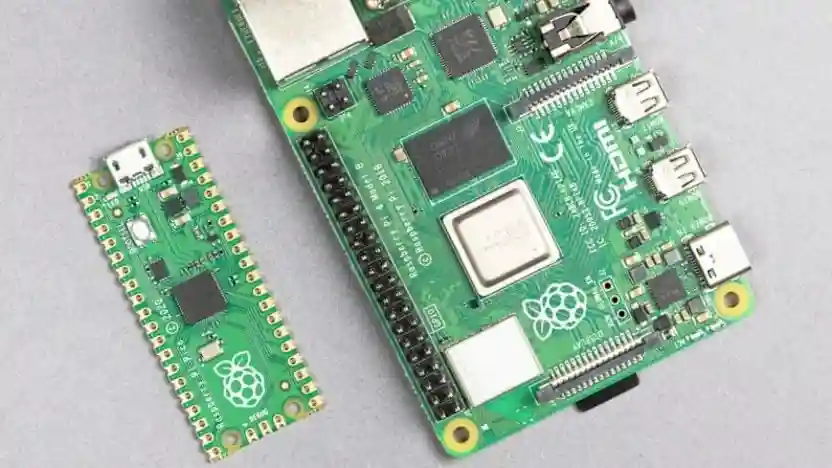
Raspberry Pi implements immediate price increases across Raspberry Pi 4, 5, and Compute Module 5 variants, with hikes ranging $5-$25 tied directly to surging RAM costs fueled by explosive AI infrastructure demand. The 16GB Compute Module 5 jumps $20 to $140 starting point, while popular Pi 5 configurations see $10-$15 uplifts reflecting DRAM shortages crippling maker and embedded markets. CEO Eben Upton acknowledges the “painful but temporary” memory crunch in official announcement, pledging reversals once AI supply pressures ease—though historical precedents suggest sticky increases persisting post-demand peaks.
New Budget Pi 5 Variant Launches at $45
Amid escalations, Raspberry Pi debuts a 1GB Raspberry Pi 5 model priced accessibly at $45, packing quad-core 2.4GHz Arm Cortex-A76 CPU, VideoCore VII GPU, dual-band Wi-Fi 5, Bluetooth 5.0, and PCIe 2.0 x1 interface for NVMe SSD expansion. This entry-level option targets hobbyists, educators, and industrial prototypes where minimal RAM suffices for headless servers, IoT gateways, or retro gaming emulation. Feature parity with pricier siblings preserves GPIO, dual 4Kp60 HDMI, and 5Gbps USB 3 ports, democratizing 64-bit Arm powerhouse amid component inflation.
AI Training Demands Devour Global DRAM Supply
Generative AI’s voracious memory appetite—large language models requiring 100GB+ HBM3 stacks per training run—hoovers high-bandwidth DRAM variants critical for Pi’s LPDDR4X modules. NVIDIA H100/A100 GPU clusters alone consumed 30%+ of 2024-2025 HBM production, spillover effects cascading through consumer/server DDR5/LPDDR5X pricing. Micron, Samsung, SK Hynix report 40-60% YoY memory price surges, forcing Pi’s vertically integrated supply chain to pass costs despite fixed BOM efficiencies from 100M+ annual shipments.
Compute Module 5 Bears Heaviest Increases
Enterprise-grade Compute Modules suffer steepest hikes: 16GB CM5s rise from $120 to $140 (+17%), 8GB from $90 to $105 (+17%), reflecting density premiums where AI edge inference favors high-RAM SKUs. Pi 5 boards follow proportionally—8GB $90→$100 (+11%), 4GB $70→$75 (+7%)—while Pi 4 holds relative stability at $5 bumps across 2-8GB tiers. Industrial customers face carrier board requalification delays as fabs prioritize AI silicon over SBC components.
Industry-Wide RAM Crunch Hits Makers Hard
CyberPowerPC canceled 2025 Black Friday RAM promotions citing identical shortages, while framework laptop delays and Beelink mini-PC markups echo Pi’s plight. AI datacenter operators lease entire DRAM production runs, sidelining consumer electronics as Micron’s HBM3E sells out through 2026 at $40/GB premiums. Pi’s 1GB Pi 5 hedges against volatility, appealing to price-sensitive clusters where distributed computing scales performance sans per-node memory excess.
Long-Term Supply Chain Implications
Upton projects abatement as TSMC/CoWoS ramp HBM4 capacity and CHIPS Act subsidies onshore US memory fab, yet AI’s projected $1T+ 2026-2030 capex sustains pressure. Pi mitigates via LPDDR5 upgrades in Pi 6 roadmaps and eMMC alternatives, but maker community’s homelab economics suffer. Open-source alternatives like Orange Pi/Rockchip pivot to cheaper NAND, though Arm performance lags Pi’s Broadcom BCM2712.
Raspberry Pi’s measured increases balance sustainability against AI-forced realities, with 1GB Pi 5 anchoring affordability amid memory Armageddon. Makers adapt via clustering or cloud migration, but datacenter spillover redefines SBC viability. As HBM shortages persist, Pi’s vertical control and volume leverage position it best for post-crunch normalization—whenever that arrives.