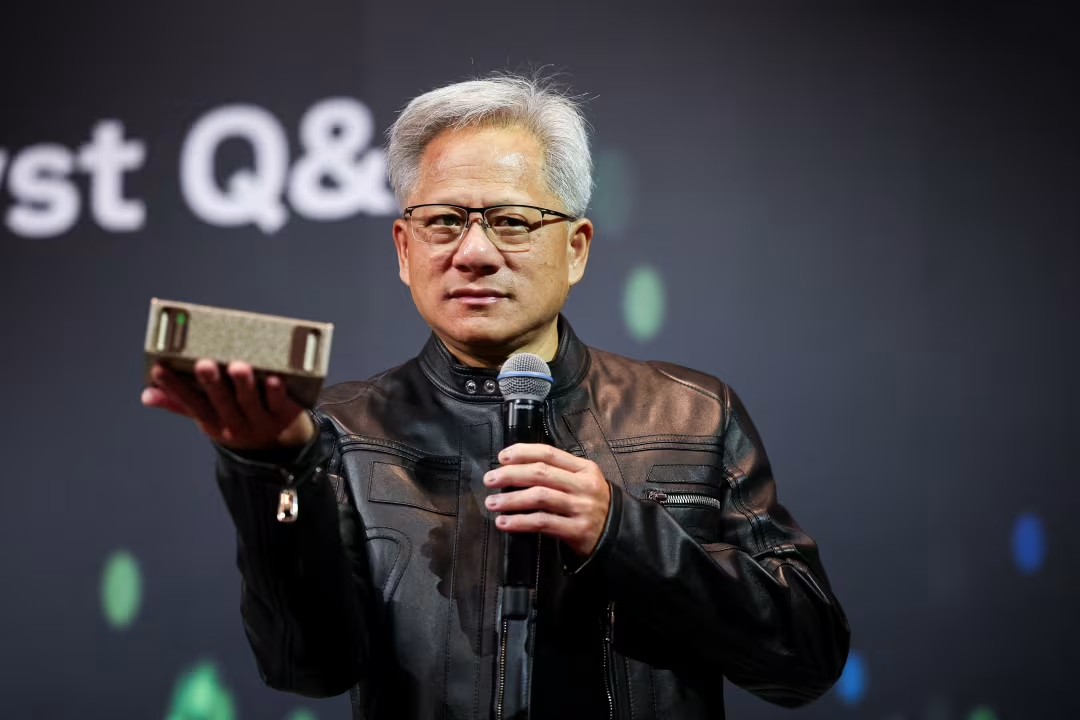
President Donald Trump announced that NVIDIA can now sell its powerful H200 AI processors to vetted commercial customers in China, ending a strict ban that limited exports to the weaker H20 model. The decision, shared via Truth Social, imposes a 25 percent U.S. tariff on these sales — higher than the previously floated 15 percent rate — while excluding NVIDIA’s latest Blackwell and upcoming Rubin chips to safeguard national security. Trump stated he personally informed China’s President Xi Jinping, who “responded positively,” with the Commerce Department finalizing details for NVIDIA, AMD, Intel and other U.S. firms.
This policy shift balances economic opportunity with security concerns, allowing NVIDIA access to China’s massive AI market without compromising cutting-edge technology. The H200, significantly more capable than the compliance-focused H20, positions American firms competitively against domestic rivals like Huawei while generating tariff revenue.
Background on U.S. AI Chip Export Controls
The Biden-era restrictions aimed to curb China’s AI military advancements by blocking high-performance GPUs. NVIDIA responded with the neutered H20, which China largely rejected in favor of Huawei alternatives. Black market channels nonetheless funneled $1 billion in restricted H100/H200 chips to unauthorized buyers, undermining sanctions.
Trump’s reversal reflects commercial pragmatism: complete exclusion risked ceding market share to Huawei, whose latest chips still trail NVIDIA’s architecture by wide margins. Approved sales target vetted enterprises, with Commerce Department oversight ensuring end-use compliance.
H200 vs. Competitors: Performance Breakdown
| Chip | Performance (TFLOPS FP8) | China Availability | Key Advantage |
|---|---|---|---|
| NVIDIA H200 | ~4,000 | Approved customers | Memory bandwidth leader |
| NVIDIA H20 | ~700 | Previously only | Export compliant |
| NVIDIA B200 (Blackwell) | ~40,000 | Banned | 10x H200 speed |
| Huawei Ascend 910B | ~2,000 | Domestic only | Self-reliant |
H200’s sixfold edge over H20 justifies the policy pivot.
Industry and Political Reactions
NVIDIA welcomed the “thoughtful balance,” noting H200 access strengthens U.S. leadership. The company loses billions annually from China exclusion, making controlled reentry critical for shareholder value.
Democrats decried it as a “colossal failure,” warning China will reverse-engineer technology for military use. Republican Rep. John Mollenaar echoed fears: “China will rip off NVIDIA’s tech, mass-produce it and end them as competitors.” National security hawks question Commerce’s vetting rigor amid Huawei’s aggressive catch-up plans.
China’s AI Ambitions and Huawei Challenge
Beijing previously instructed firms to shun U.S. chips, boosting Huawei’s domestic alternatives. The telecom giant unveiled a three-year roadmap to surpass NVIDIA/AMD, leveraging government subsidies and SMIC fabrication. Experts like Richard Windsor maintain NVIDIA’s architectural lead remains unassailable, with Huawei trailing in software ecosystems and yield efficiency.
H200 approval tests China’s rhetoric versus reality. Approved buyers — likely cloud giants like Alibaba and Tencent — gain inference/training advantages, potentially accelerating domestic model development while funding U.S. innovation through tariffs.
Economic Stakes for NVIDIA and U.S. Tech
China represents 20-25% of NVIDIA’s pre-ban revenue. H200 sales could add billions quarterly, stabilizing stock amid Blackwell ramp-up. Tariffs offset security risks, channeling funds to Commerce oversight.
AMD/Intel follow similar paths, preserving U.S. dominance while extracting economic value. The model prefigures future tech diplomacy: controlled access over outright bans, mirroring rare earths negotiations.
Security Safeguards and Vetting Process
Commerce’s “approved customers” framework mirrors EAR licensing:
– End-user certifications prohibiting military diversion.
– Real-time transaction monitoring.
– Audit trails for chip deployment.
– Kill switches in firmware for violations.
Blackwell/Rubin exclusion protects frontier capabilities: B200 delivers 10x H200 throughput for trillion-parameter models. Violations trigger permanent bans, as seen with prior smugglers.
Global AI Arms Race Implications
The decision recalibrates U.S.-China tech decoupling. Europe eyes similar carveouts; Taiwan bolsters TSMC security. Huawei accelerates, but ecosystem gaps — CUDA vs. CANN — hinder parity.
For enterprises, H200 availability enables cost-effective scaling without full domestic pivot. Researchers gain compute absent from embargoed channels. Investors anticipate NVIDIA margin expansion as China revenue rebounds.
Trump’s move embodies “America First” pragmatism: extract value from adversaries, protect crown jewels, let competitors chase shadows. As Xi weighs response, the AI chessboard gains new pieces — with NVIDIA holding strongest position.