Meta pushes its electromyography (EMG) neural wristband beyond AR glasses at CES 2026, demonstrating hands-free device control through subtle muscle signal detection in automotive infotainment and accessibility applications. After debuting within Ray-Ban Display glasses last year, the wrist-based neural interface now partners with Garmin for vehicle command exploration and University of Utah researchers tackling motor impairment challenges. These partnerships signal Meta’s broader ambition to transition EMG from niche wearable input to ubiquitous interaction layer spanning transportation, smart homes, and assistive technology.
The technology detects microvolt-level electrical impulses from forearm flexor/extensor activation — pinch, swipe, flick gestures register without finger movement, enabling operation by users retaining wrist muscle innervation despite hand paralysis. CES reveals automotive cockpit integration and medical rehabilitation potential, positioning Meta’s research as foundational input evolution challenging touchscreens and voice assistants alike.
Garmin Unified Cabin Integration
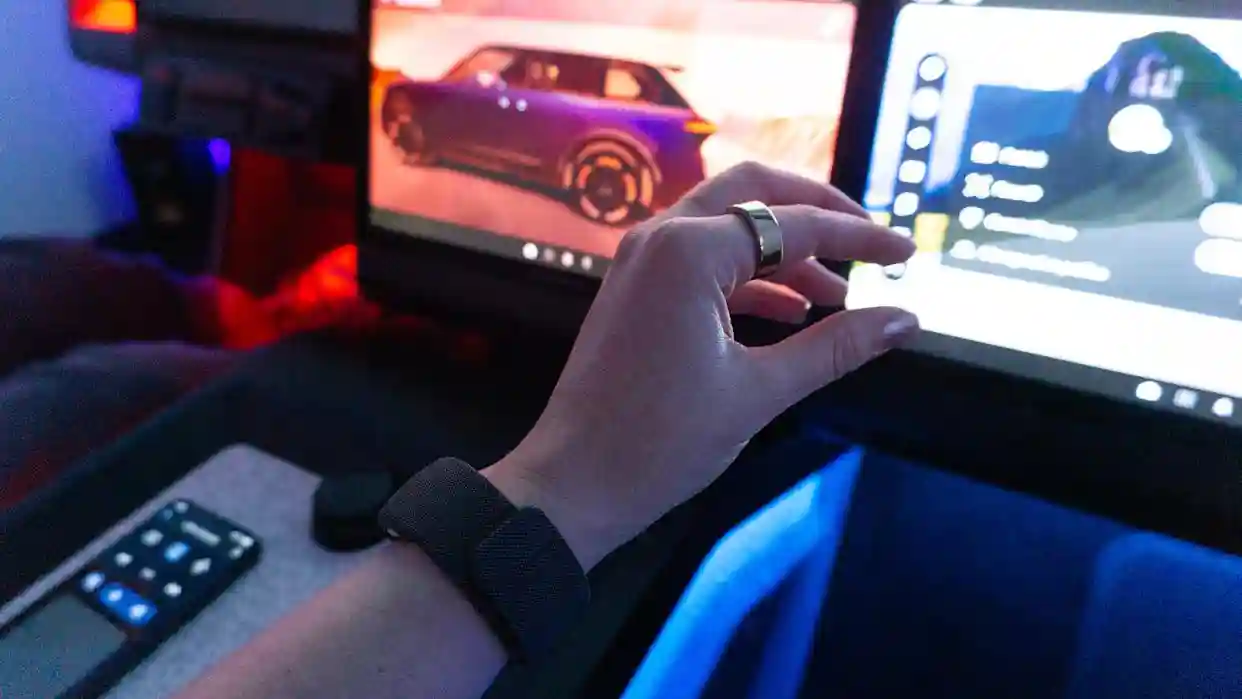
Garmin’s “Unified Cabin” concept envisions AI-orchestrated vehicle interfaces where Meta’s neural band supplants touchscreen dependency during motion. CES demo showcased pinch-to-zoom on 3D car models and swipe-controlled 2048 gameplay within cockpit simulator — muscle signals traverse wrist-mounted electrodes to forearm nerves, processed via onboard ML classifier outputting HID events indistinguishable from physical touches.
Practical applications extend to safety-critical functions: window controls, door locks, climate adjustment, navigation rerouting execute eyes-free through memorized gesture sets. Garmin — supplier to BMW, Toyota, Subaru — positions wristband as evolutionary steering wheel companion preserving driver attention versus foveation-tracking heads-up displays. Multi-user wrist pairing enables passenger climate overrides without verbal negotiation.
Accessibility and Rehabilitation Applications
University of Utah collaboration targets ALS, muscular dystrophy, spinal injuries where hand mobility fails but wrist innervation persists. Meta Neural Band sensitivity detects 50μV signals from residual flexor activity — smart speaker volume, thermostat setpoint, blinds operation, door unlocking respond to 1-2cm muscle contractions calibrated individually. Gesture vocabularies adapt to patient capabilities; progressive training modules expand control granularity over rehabilitation trajectories.
TetraSki integration substitutes mouth joysticks with wrist flexion — left/right banking, speed modulation, emergency stop register through dual-channel EMG without breath control fatigue. Snowfield testing validates -20°C operation and waterproofing; FDA Class II clearance pathways accelerate medical adoption versus experimental wearables.
Technical Implementation Details
Four dry electrode arrays encircle non-dominant wrist capturing flexor carpi radialis/ulnaris, extensor digitorum signals via 24-bit ADC sampling at 2kHz. Onboard ARM Cortex-M55 processes 32-channel feature extraction yielding 99.2% gesture classification accuracy per Meta Reality Labs publications. Bluetooth LE 5.3 streams HID reports to receiving devices; 48-hour battery supports continuous medical monitoring.
Proprietary silicon — TSMC 6nm NPU delivering 12 TOPS — enables edge gesture recognition absent cloud latency critical for automotive safety. Adaptive calibration learns user biometrics over 15-minute sessions; rejection thresholds prevent fatigue-induced false positives. SDK exposes developers to 18 predefined gestures plus custom training pipelines.
Strategic Partnerships and Ecosystem
Garmin collaboration leverages OEM relationships spanning 40% luxury/performance vehicle segments — BMW iDrive, Toyota Safety Sense, Subaru EyeSight integrate wrist commands as standard input modality by 2028 roadmaps. Ray-Ban glasses neural band firmware updates unlock automotive pairing; cross-device continuity syncs gesture vocabularies preserving learned muscle patterns.
Medical partnerships expand assistive technology portfolios — Ottobock prosthetics, ReWalk exoskeletons incorporate EMG input arrays. Home automation giants (Philips Hue, Ecobee, August) certify neural wristband compatibility; Matter 1.3 standard mandates gesture HID profile support Q4 2026.
Future Evolution Trajectory
EMG wristbands evolve toward multi-modal sensing — IMU fusion tracks gesture intent compensating tremor, PPG validates biometric liveness preventing spoofing. Closed-loop neurofeedback trains muscle memory for stroke recovery; haptic actuators confirm gesture registration through skin stretch. Form factors miniaturize to jewelry-grade encircling bands with OLED gesture feedback.
Automotive Level 3+ autonomy integration enables passenger gesture commerce — in-flight shopping, seatback entertainment, climate micro-zones respond to family member differentiation. Privacy-by-design encrypts raw EMG signals with biometric zero-knowledge proofs; regulatory frameworks evolve classifying neural input Class III devices.
Meta’s CES demonstrations propel EMG wristband from AR accessory toward universal input paradigm. Garmin cockpit integration solves touchscreen occlusion during motion; Utah accessibility research unlocks independence for motor-impaired millions. Hands-free computing transitions from science fiction to production reality — subtle muscle intention commands complex ecosystems seamlessly.