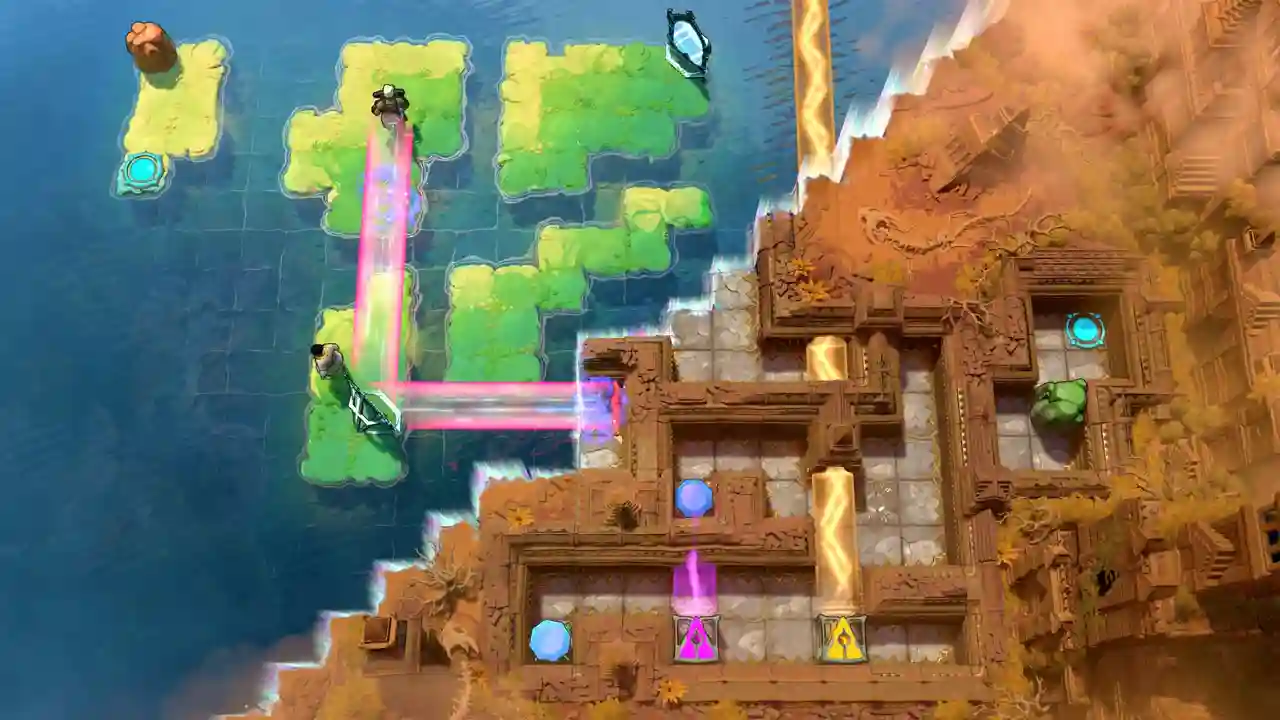
After nearly a decade of quiet, iterative creation, Jonathan Blow — the acclaimed developer behind *Braid* and *The Witness* — is once again ready to challenge players’ minds with a monumental new project. His latest effort, *Order of the Sinking Star*, is not just a game but an obsession nine years in the making, featuring roughly **1,400 puzzles** and a scope so massive it could consume hundreds of hours for the most dedicated players. What began as a “small side project” has grown into what may be one of the most ambitious puzzle games ever designed.
A Modest Start That Grew Out of Control
When *The Witness* launched in 2016 after six years of meticulous development, Blow thought he was due for a smaller, simpler venture. His initial goal was to use the project as a proof of concept—testing a new programming language and engine created by his studio, Thekla. “It was supposed to be a short game,” he admitted, “like a year and a half or two years.”
But Blow’s creative process, driven by a determination to “make every idea the best version of itself,” quickly stretched those early plans beyond recognition. As puzzles multiplied, so did the complexity of the interlocking systems. The result is *Order of the Sinking Star*, an experience that blends mathematical rigor with artistic elegance, embodying Blow’s perfectionist design philosophy.
A Labyrinth of Logic and Discovery
At first glance, *Order of the Sinking Star* is built on deceptively simple mechanics reminiscent of early 2D tile-based puzzle games. Players navigate a sprawling world mapped on grids, each path leading to new variations of core mechanics. From a central hub, players can travel in four distinct directions, each introducing unique puzzle families that evolve independently before merging in the game’s later stages.
Among these paths:
– One branch, “The Hearty Heroes of Hauling,” centers around puzzles involving the precise manipulation of blocks across patterned grids.
– Another, “Mirror Isles,” transforms logical reasoning into geometric experimentation, challenging players to teleport or clone themselves across reflective surfaces.
– A third world revolves around stepping-stone paths over shimmering waters, forcing players to think several moves ahead.
– The final path introduces an energy-beam exoskeleton that grants evolving abilities, each new mechanic expanding the game’s combinatorial complexity.
As players unlock each branch, they steadily approach an “important golden chamber”—a pivotal point where all four worlds begin blending their mechanics. These hybrid puzzles form the intellectual heart of the game, offering limitless permutations and combinations that demand creative synthesis from everything learned so far.
Pushing Puzzle Design to Its Mathematical Limits
Blow describes the structure as a “combinatorial explosion” of possibilities, with each solved puzzle unlocking layers of mechanics that interact in surprising ways. “When you combine the systems,” he explained, “the game really blows up in possibility.” His team, he added, worked tirelessly to ensure that “everything here is in its right place—ritualistically, mathematically, and fictionally.”
The first major arc may take most players between **60 and 100 hours** to complete, at which point they’ll reach a satisfying “first ending.” But for those willing to dive deeper, hidden mechanics and concealed paths lead to an extensive endgame. “There are whole subjects we’re not even talking about yet,” Blow teased, hinting at discoveries that could stretch the experience to **500 hours or more**.
From Isolation to Iteration: Embracing Playtesting
One major shift in Blow’s process with *Order of the Sinking Star* is his newfound reliance on playtesters. Historically wary of player feedback—believing excessive testing tends to homogenize design—Blow realized this project’s enormity demanded outside perspectives. “It doesn’t fit in my brain all at once,” he explained. “We have to playtest it because it’s too large and too complex not to.”
These sessions have reportedly helped refine the pacing and progression across the hundreds of interconnected puzzles, ensuring clarity without compromising on challenge. For a designer often described as solitary and meticulous, this newfound openness marks a notable evolution in his approach.
The Cost of Ambition
Spending nine years developing a single game might sound extravagant, but Blow acknowledges that his financial independence—secured by the commercial success of *The Witness*—made it possible. That earlier project grossed millions within its first week, affording Thekla the luxury of chasing abstract, research-driven design goals instead of chasing deadlines. “We created this giant possibility space,” Blow said. “Once that happens, you can’t just stop halfway—you have to explore it fully.”
Still, even Blow admits that *Order of the Sinking Star*’s protracted production has taken its toll. “It’s been very expensive,” he confessed. “I’ll be happy to get it out and have a new game making money, because we need that to happen at this point.” Despite these pressures, his commitment to artistic integrity appears unchanged.
The Timeline of Jonathan Blow’s Creative Trajectory
| Project | Release Year | Development Time | Signature Feature |
|---|---|---|---|
| Braid | 2008 | ~3 years | Time manipulation platforming |
| The Witness | 2016 | 6.5 years | Island of interconnected line puzzles |
| Order of the Sinking Star | Planned 2026 | ~9 years | 1,400 interlinked grid puzzles, emergent mechanics |
Perfectionism Without Regret
Though often portrayed as uncompromising, Blow now sees his long projects less as perfectionist indulgence and more as necessary depth. “I might have been a perfectionist when I was younger,” he reflected. “Now it’s just wanting to do something really good.” His aim is to craft games that function both as art and systems of knowledge—experiences that reward not only play, but genuine understanding.
As *Order of the Sinking Star* moves toward its 2026 launch, anticipation within the indie community is building. For players who found enlightenment in *The Witness*, this new labyrinth of logic promises something even grander—a world where intellect, patience, and curiosity are their own rewards. And much like the stars that guide its title, this game looks destined to shine brightest for those willing to lose themselves in its intricate, infinite design.