The second season of *Fallout* faces an almost unfair challenge — building upon the roaring success of its debut while daring to draw direct inspiration from *Fallout: New Vegas*, the most revered entry in the long-running video game franchise. Yet, when the new season lands on Prime Video, it defies the usual sophomore slump. Rather than retreating into safe repetition or bloated expansion, the series doubles down on everything that made season one so unforgettable: biting humor, violent chaos, and a level of absurdity that somehow feels emotionally authentic amid radioactive wastelands.
A Seamless Continuation with Familiar Faces
Picking up right where the first season left off, season two plunges us back into the wasteland following Lucy (Ella Purnell) and The Ghoul (Walton Goggins) as they continue their hunt for Lucy’s missing father. From the first episode, their unlikely partnership reasserts itself as the beating heart of the show. Lucy’s unwavering optimism, charisma, and moral stubbornness collide beautifully with The Ghoul’s grizzled pragmatism, shaped by centuries of brutal survival. Their contrasting energy keeps the tone taut, oscillating between moments of gruesome realism and wry levity.
Walton Goggins once again steals scenes with ease. Whether delivering deadpan lines like “Do more drugs” or recounting bleak life lessons, his performance layers sharp wit inside quiet tragedy. Purnell’s Lucy complements him perfectly—her naïveté isn’t a weakness but a moral compass reminding us of what humanity used to be. Together, they embody *Fallout’s* central tension: the coexistence of hope and cynicism in a world that constantly mocks both.
An Expanded Universe, Not a Bloated One
One of the most common pitfalls of a sequel season is narrative inflation—introducing too many storylines that dilute focus. Yet *Fallout* handles its sprawling arcs with surprising finesse. The show balances multiple plots: Lucy’s familial quest, the internal turmoil of the Brotherhood of Steel, and the strange existential dilemmas unfolding within surviving vaults. Each storyline maintains momentum without stepping on the others, delivering a pace that feels deliberate yet energetic.
Aaron Moten’s Maximus receives more screen time this season as his role within the Brotherhood expands. However, while his storyline occasionally lags behind others in emotional impact, it remains thematically relevant. His moral evolution, though slower and more passive, reflects the difficulty of finding integrity in an institution that thrives on rigid hierarchy. Maximus is a soldier quietly questioning his orders in a world that punishes independent thought—a familiar yet potent *Fallout* theme.
Elsewhere, Moises Arias shines as Norm, Lucy’s brother, whose newfound leadership displays a blend of humor, insecurity, and emotional intelligence. Annabel O’Hagan also impresses as Overseer Harper, effortlessly shifting from vulnerable to volatile as she juggles power and madness. The depth of these supporting performances amplifies the unpredictability of the wasteland, where even secondary characters can hijack entire episodes through sheer force of personality.
New Vegas Reimagined for Television
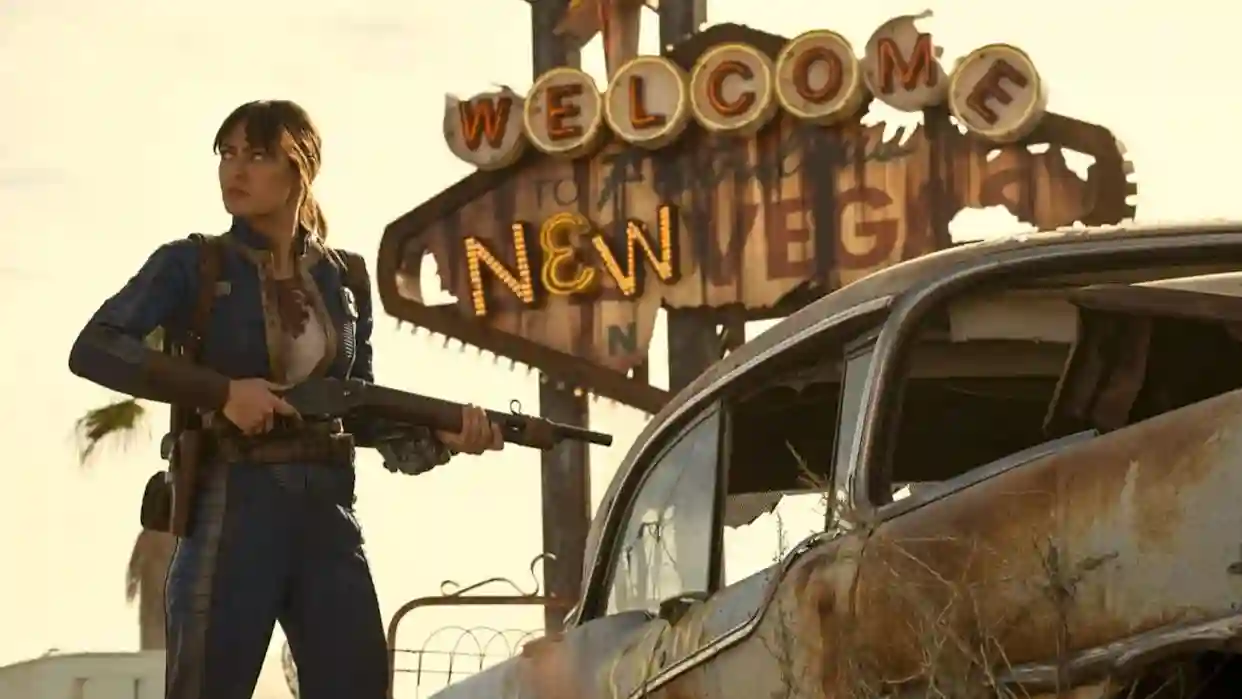
The move to New Vegas could have been a risky gamble, given the game’s legendary fan status, but the showrunners approach it with reverence and restraint. Visually, New Vegas emerges as a luminous mirage rising from decay—a decadent ruin of pre-war excess that embodies the show’s theme of civilization’s self-inflicted wounds. The production design excels, capturing the juxtaposition of neon glamour and radioactive desolation that defines the setting.
It’s worth noting that the series doesn’t even reach the city until midseason, but that pacing works in its favor. Instead of rushing toward fan service, *Fallout* uses the early episodes to earn the journey, making every encounter feel like a step through the game’s branching dialogue trees. By the time the titular city appears, it feels monumental—earned rather than forced.
Fan Service Done Right
For longtime fans of the franchise, *Fallout* season two is a treasure trove of easter eggs and subtle nods. From fleeting shots of Nuka-Cola to old-world posters, everything in the background feels meticulously curated. The show even finds space to introduce recognizable figures, including everyone’s favorite cowboy-coded security robot, whose cameo strikes the perfect balance between nostalgia and narrative utility.
The show also pays homage to the broader *Fallout* universe by exploring factions like the New California Republic (NCR) and Caesar’s Legion. Rather than overwhelming newcomers with lore dumps, these inclusions are woven naturally into the story, functioning both as world-building and as reflections on ideology and survival. Once again, *Fallout*’s writing captures the irony and tragedy of humanity clinging to systems that broke long ago.
Performances and Production Design
Visually, the series continues to impress. The sets are grimy and grand in equal measure, turning the wasteland itself into a breathing, decaying character. Cinematography plays with contrast—arid expanses burst with radioactive sunlight by day and plunge into haunting silence at night. The richly textured costume design echoes the improvised nature of survival, from patched leathers to scavenged armor pieces.
The tone remains uniquely *Fallout*: a mix of brutal violence, warped humor, and philosophical undercurrent. It’s simultaneously grotesque and beautiful—never letting the audience forget that humanity’s broken world endures only by laughing at its own despair. Director-driven flourishes ensure the absurd never feels disjointed, maintaining cohesion between slapstick radiation gags and heart-wrenching moral debates.
Comparison to Other Game Adaptations
| Show | Season 2 Approach | Reception | Overall Tone |
|---|---|---|---|
| Fallout | Expands scope while deepening character arcs | Praised for consistency and creativity | Darkly comedic, gritty, heartfelt |
| The Last of Us | Focused on emotional continuity but expanded lore | Critically strong but divisive pacing | Somber and intimate |
| Halo | Major tonal shift midseries | Mixed reviews from fans | Action-driven, less character-focused |
This comparison illustrates how *Fallout* stands apart: it embraces its chaos, celebrates its weirdness, and never apologizes for its camp. Unlike its peers, it doesn’t chase prestige—it revels in its grime, yet still delivers emotional resonance beneath the surface absurdity.
A Worthy Successor and Confident Evolution
Even with multiple storylines and a sprawling cast, *Fallout* season two feels composed rather than chaotic. The pacing rarely falters, and each episode finds a tonal balance between grotesque humor and emotional sincerity. The writing intelligently uses absurdity as a mirror for human resilience, asking whether decency can survive in a world built on debris.
In short, *Fallout*’s second season doesn’t just survive the shadow of *New Vegas*—it triumphs beneath its glow. Sharp writing, stellar performances, and a deep understanding of the source material transform what could have been derivative into something extraordinary. It’s riotous, biting, and unexpectedly moving. Instead of experiencing a downturn, *Fallout* doubles down on everything it does best, proving once again why this series remains one of the finest video game adaptations ever produced. Viva New Vegas, indeed.