
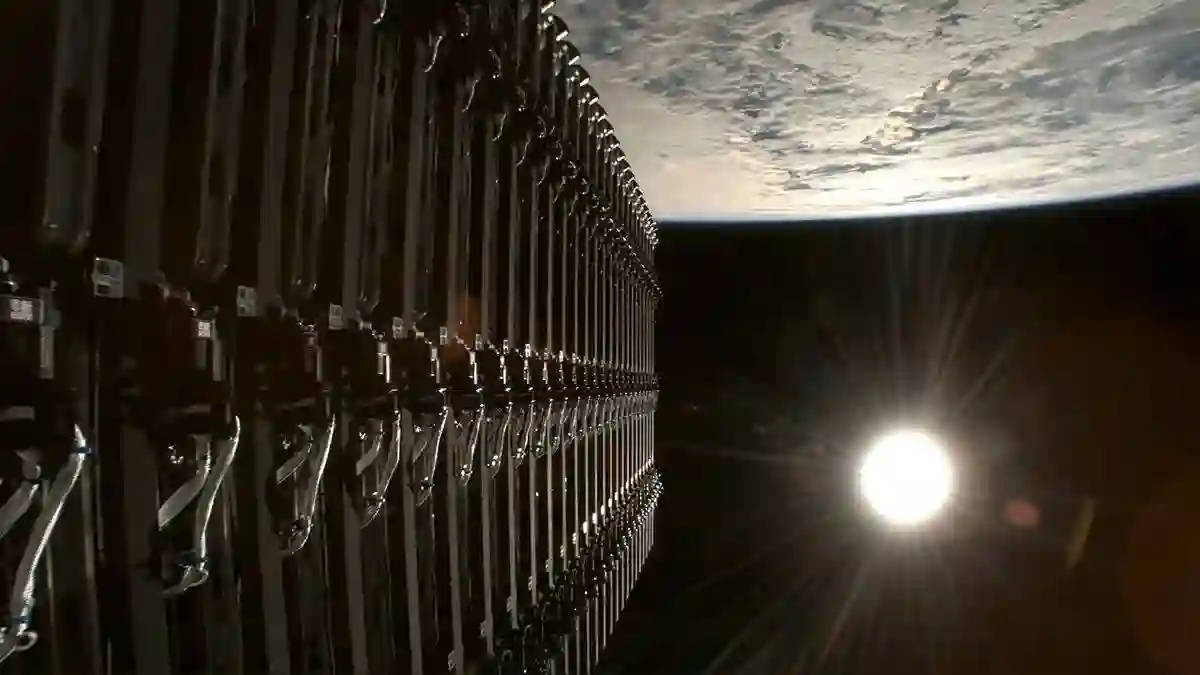
A Starlink satellite suffered a dramatic failure when a propulsion tank anomaly triggered what appears to have been a small onboard explosion, scattering trackable debris across low Earth orbit and highlighting the growing risks of massive satellite constellations. SpaceX confirmed the incident involved venting from the satellite’s propulsion system, causing a rapid 4 km drop in its orbital path and the release of low-velocity fragments now monitored by ground-based radars. Orbital tracking firm LeoLabs quickly determined the event stemmed from an internal energetic source rather than a collision, underscoring vulnerabilities in satellite design as SpaceX rapidly expands its network toward 12,000 operational craft.
Immediate Response and Debris Tracking
SpaceX immediately coordinated with NASA and the US Space Force to monitor the satellite’s trajectory and fragmented remains, emphasizing that the largely intact craft is tumbling harmlessly below the International Space Station’s altitude. The company projects full atmospheric reentry and demise within weeks, minimizing long-term collision hazards in crowded orbital regimes. LeoLabs’ rapid assessment prevented unnecessary panic about cascading debris events, though the exact number of trackable objects remains undisclosed pending comprehensive scans.
This marks a rare public admission of propulsion failure for Starlink’s v2 mini satellites, which rely on krypton-fueled ion thrusters for station-keeping and deorbit maneuvers. Such incidents test SpaceX’s operational maturity, as the constellation’s sheer scale—nearly 9,300 active satellites comprising 65 percent of tracked spacecraft—amplifies any single failure’s visibility and potential consequences.
Context of Recent Near-Misses
The explosion occurred mere days after a separate high-risk conjunction between a Starlink satellite and a Chinese CAS Space craft, which SpaceX attributed to inadequate ephemeris sharing between operators. Starlink VP Michael Nicholls warned that uncoordinated maneuvers invite “dangerously close approaches,” a critique leveled amid escalating Sino-American space competition. With China deploying its own mega-constellations like Qianfan, orbital traffic management emerges as a critical geopolitical flashpoint.
Starlink’s explosive growth exacerbates these tensions: 3,000+ satellites launched in 2025 across 121 Falcon 9 missions—roughly one every three days—pushes low Earth orbit toward saturation. Each satellite carries sophisticated collision avoidance systems executing thousands of daily maneuvers, yet human factors like data-sharing reluctance persist.
Technical Breakdown of the Anomaly
Propulsion tank venting suggests a pressure rupture or valve malfunction during attitude control burns, common failure modes in high-thrust chemical systems. Unlike collision-induced breakups, internal explosions produce lower-energy debris clouds with predictable dispersion patterns, facilitating safer tracking. Starlink’s design philosophy prioritizes rapid deorbit capability—satellites autonomously burn remaining fuel upon failure—reducing zombie satellite proliferation plaguing legacy constellations.
| Aspect | Starlink Satellites | Typical LEO Satellites |
|---|---|---|
| Active Count | ~9,300 | Diverse (thousands) |
| Deorbit Time | Weeks | Years/decades |
| Collision Avoidance | Automated burns | Manual/operator-dependent |
| Debris Generation Risk | Low-velocity fragments | High-energy shrapnel |
Implications for Mega-Constellation Operations
This event spotlights propulsion reliability as Starlink scales to Phase 2 deployments with larger v3 satellites boasting enhanced thrust for polar orbits and inter-satellite laser links. A single tank rupture generates dozens of trackable objects, straining global Space Surveillance Networks already overwhelmed by Starlink’s volume. While current debris poses negligible manned flight risks, cumulative failures could seed Kessler Syndrome precursors in popular 500-600 km shells.
SpaceX’s transparency contrasts with state actors’ opacity, positioning Starlink as a de facto orbital traffic cop through its vast sensor array. International regulators like the FCC demand stricter anomaly reporting, potentially mandating real-time data feeds for all operators. Competitors including Amazon’s Kuiper and China’s constellations face identical scaling pains, necessitating standardized collision avoidance protocols.
Future Safeguards and Industry Evolution
Lessons from this incident will refine satellite passivation—rendering propulsion systems inert post-failure—and enhance ground-based anomaly detection via machine learning. SpaceX’s vertical integration accelerates iterative fixes, with upcoming launches incorporating reinforced tanks and redundant valves. Broader industry shifts toward nuclear-electric propulsion promise reduced explosion risks through lower pressures.
As Starlink dominates global broadband from space, such failures underscore the double-edged sword of proliferation: unprecedented connectivity versus orbital fragility. With 42,000 satellites approved and direct-to-cell services ramping, robust failure mitigation becomes existential. SpaceX’s swift handling reaffirms operational excellence, yet reminds stakeholders that taming low Earth orbit demands collective vigilance amid accelerating commercialization.