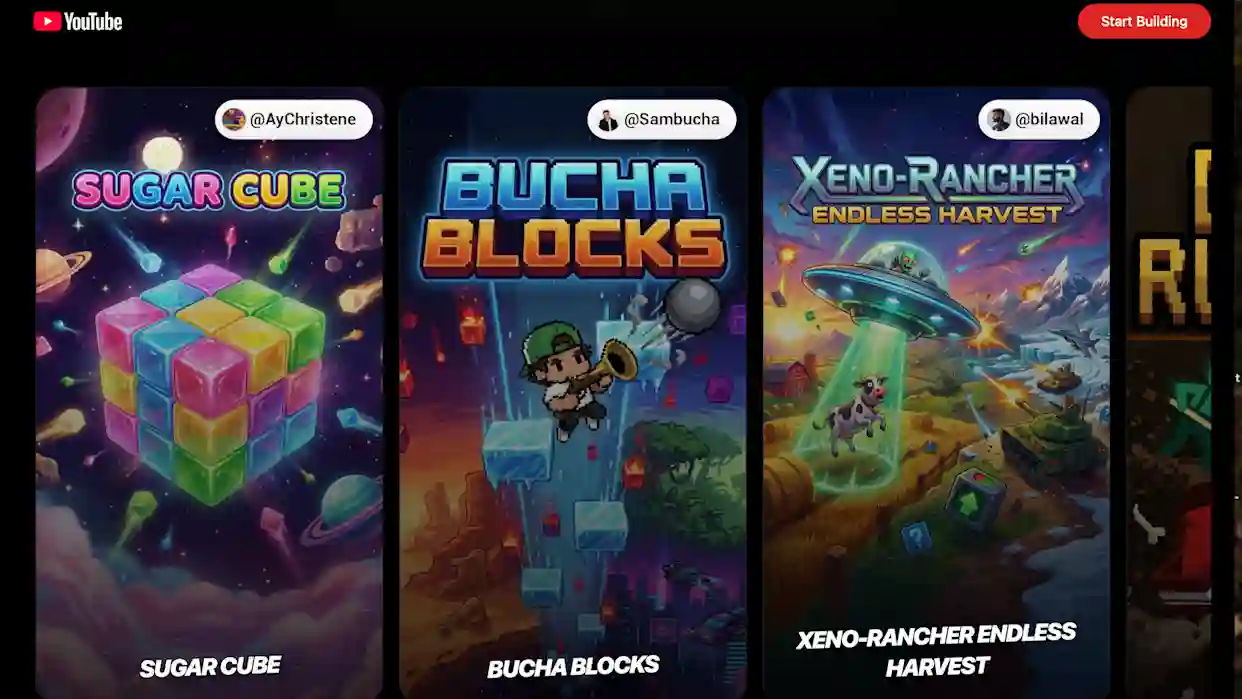
YouTube Gaming has unveiled an intriguing new tool called Playables Builder, entering an open beta that lets select creators build simple games using nothing but text, video, or image prompts powered by Gemini 3. Announced on December 16, this prototype web app represents Google’s latest push to embed artificial intelligence deeper into content creation, specifically targeting YouTube’s vast network of creators who want to experiment with interactive gaming without coding expertise. Partnering with influencers like Sambucha, AyChristene, GoharsGuide, and Mogswamp, the platform aims to democratize game development, allowing anyone with a channel to generate bite-sized experiences directly within the YouTube ecosystem.
From Testing to Creator Empowerment
YouTube’s journey into mini-games began quietly in 2023 with tests of small-scale playable content on desktop and mobile platforms. By last year, the company expanded this into full multiplayer support within its Playables feature, enabling shared sessions among viewers and friends. Playables Builder takes this concept further by handing the reins to creators themselves. Using Gemini 3’s advanced multimodal capabilities, users input a simple description—”a endless runner with jumping cats”—and the AI generates a fully functional game complete with mechanics, visuals, and controls.
The closed beta limits access to invited creators, ensuring initial feedback shapes the tool before wider release. Early demos showcased everything from puzzle games to arcade-style challenges, all rendered in a lightweight format optimized for web browsers. This aligns with YouTube’s strategy to keep users engaged longer on the platform, blending video consumption with interactive entertainment in a seamless loop.
No-Code Game Creation Made Simple
At its core, Playables Builder eliminates traditional barriers to game development. Creators no longer need Unity expertise, asset libraries, or programming knowledge. Instead, they describe their vision in natural language, upload reference images or clips, and let Gemini 3 handle the heavy lifting. The AI interprets prompts to create responsive gameplay loops, collision detection, scoring systems, and even basic sound design.
For example, a beauty vlogger could prompt “a makeup matching quiz where players drag colors to faces,” instantly producing a branded mini-game to embed in videos. Gaming influencers might request “a 2D battle royale with viewer voting,” generating prototypes for community testing. The tool’s output is instantly playable and shareable via YouTube links, fostering viral loops where fans play, share scores, and inspire iterations.
Google’s AI Everywhere Philosophy
This launch fits squarely into Google’s aggressive AI integration across services. Similar to recent Labs experiments like Disco and GenTabs—which turn browser tabs into interactive AI widgets—Playables Builder leverages Gemini 3 to transform vague ideas into functional products. Google’s vision positions AI as the ultimate creative accelerator, bridging the gap between inspiration and execution.
Critics argue this approach risks superficiality. Games demand balance, pacing, and player psychology—elements honed through years of iteration that AI might approximate but rarely master. Early tests show promise for casual prototypes but highlight limitations in depth, such as repetitive mechanics or inconsistent difficulty curves. Still, for YouTube’s creator economy, where quick engagement trumps polish, the tool fills a real niche.
Playables Builder vs. Traditional Game Tools
| Aspect | Playables Builder (AI) | Traditional Tools (Unity, Godot) |
|---|---|---|
| Skill Required | Basic prompting | Programming, design expertise |
| Development Time | Minutes | Weeks to months |
| Output Quality | Casual prototypes | Polished, scalable games |
| Customization Depth | Prompt-based iteration | Full code control |
| Best Use Case | YouTube content, quick experiments | Commercial releases, complex projects |
This comparison underscores Playables Builder’s strength in accessibility over professional-grade depth, targeting creators who prioritize speed and integration over standalone titles.
Potential Impact on Creator Content
For YouTube’s 100+ million creators, Playables Builder could redefine video strategies. Imagine unboxing videos ending with playable product simulators, cooking channels featuring ingredient-matching games, or fitness influencers building workout challenges. Multiplayer integration means live streams where viewers join creator-hosted sessions, boosting retention and community interaction.
Monetization opportunities emerge too. Successful Playables could integrate Super Chats, memberships, or ad placements, turning games into revenue streams. YouTube’s algorithm already favors interactive content; games could skyrocket watch time, positioning early adopters as pioneers in “playable entertainment.”
Challenges remain, however. AI-generated games risk uniformity—Gemini 3’s patterns might produce similar mechanics across prompts. Creators will need prompting mastery to stand out, much like SEO optimization today. Ethical questions around AI authorship and fair play in competitive modes also loom.
Broader Implications for AI in Gaming
Google’s experiment tests whether AI can meaningfully contribute to game design beyond asset generation. While tools like Roblox Studio already empower non-coders, Playables Builder’s conversational interface lowers the barrier further. Success here could inspire rivals—Twitch with Amazon Q, TikTok with ByteDance models—to follow suit.
Critics rightly note AI’s limitations in crafting emotionally resonant experiences. Games thrive on surprise, challenge, and narrative payoff—human dev teams excel here through playtesting and intuition. Yet for micro-experiences under five minutes, AI suffices, potentially flooding YouTube with endless casual content.
The Future of Playable YouTube
Playables Builder signals YouTube’s evolution from video host to interactive platform. As Gemini 3 matures, expect richer mechanics, procedural worlds, and viewer-influenced generation. Creators might co-design live, adapting games based on chat input—a new entertainment paradigm.
Whether it revolutionizes gaming or remains a novelty depends on iteration. For now, it empowers creators to experiment freely, proving AI’s value in democratizing digital creativity. In a content-saturated world, the ability to build and share games instantly could be YouTube’s next engagement killer.