
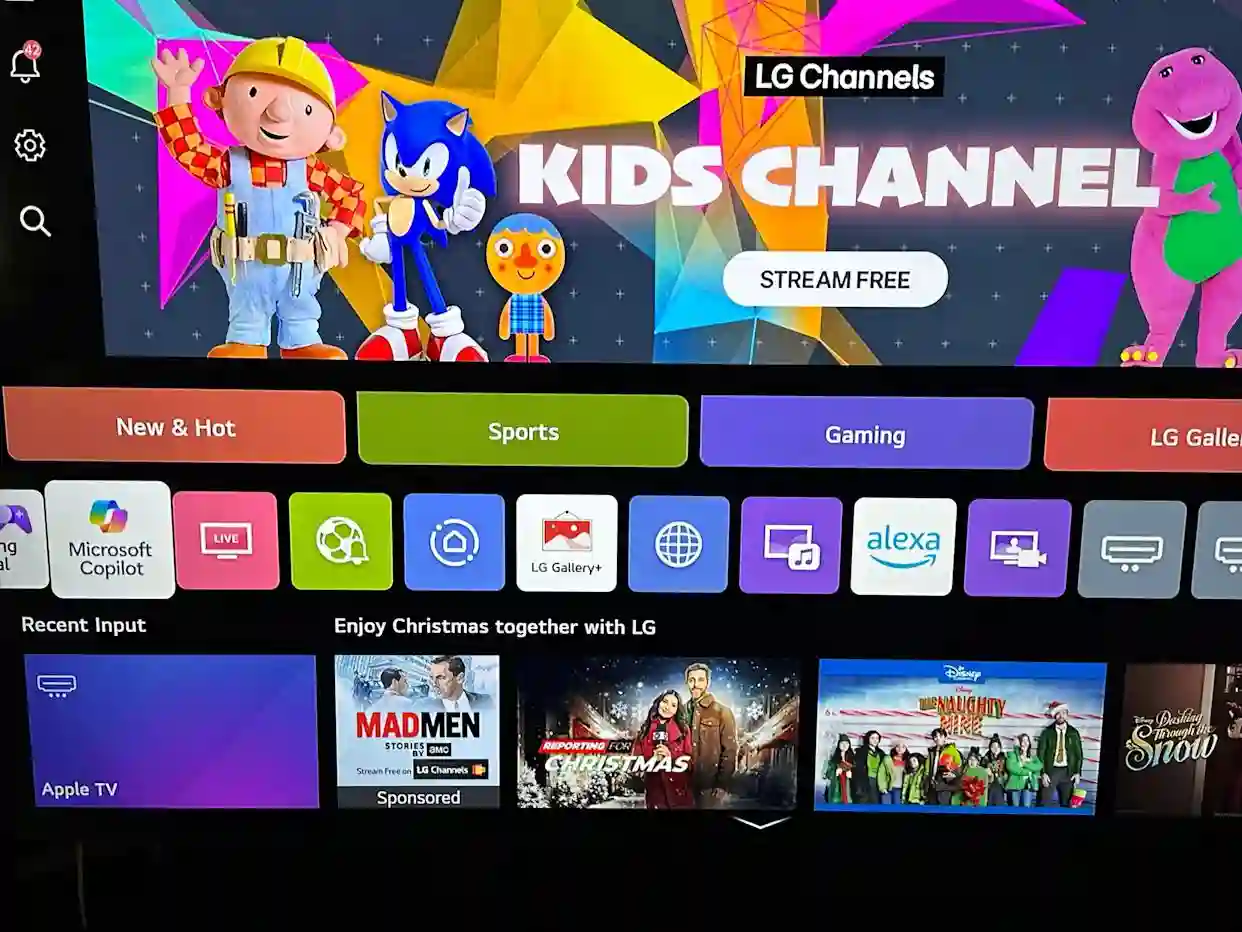
LG has quietly rolled out a controversial update that installs Microsoft’s Copilot app directly onto its smart TVs — and users can’t remove it. The AI assistant, now appearing as a built-in application, has caught many LG owners off guard. Reports across user forums reveal frustration with the latest software update, which adds Copilot without permission and prevents uninstallation. Although the app can be hidden from the TV’s home interface, it remains permanently installed within the system’s software framework. The move has reignited debates over consumer control, digital privacy, and the growing trend of forced AI integration in everyday devices.
An Unwelcome Guest on LG Smart TVs
According to multiple LG TV owners, the Copilot app appeared suddenly following a routine software update pushed in mid-December. Users on online discussion boards described finding the new app preloaded and locked from removal. Even several tech journalists and professionals confirmed the same experience on models such as the 2022 LG OLED and the 2023 UA8000. While the ability to hide the app helps keep it out of view, users cannot delete or disable it entirely, revealing LG’s deeper integration with Microsoft’s AI services.
Interestingly, not every LG television seems affected. Some users report no sign of Copilot on older models or systems where privacy permissions limit LG’s data access. This inconsistency suggests that the rollout may depend on region, model generation, or specific privacy settings. Regardless, enough consumers have experienced the change for it to become a public issue, raising questions about consent and transparency in software updates.
How Microsoft Copilot Ended Up on Your TV
The addition of Copilot appears to stem from LG’s collaboration with Microsoft to enhance its smart TV ecosystem. Earlier in the year, during the 2025 CES season, LG announced plans to include “AI-powered search and recommendation” features across its next generation of TVs. Copilot, Microsoft’s conversational AI assistant, was promoted as part of that initiative, designed to help users navigate content, settings, and device features using natural language commands.
However, what might have been a promising integration has instead triggered frustration. Unlike optional apps or features, Copilot has been embedded at the system level, meaning it’s treated as core software. This decision prevents removal for technical stability reasons, similar to how manufacturers preinstall system apps on phones. Unfortunately, in the context of home entertainment devices, users see it as intrusive and unnecessary — especially when Copilot’s popularity among PC users remains lukewarm at best.
Concerns Over Control and Privacy
For many users, the biggest issue isn’t necessarily the existence of Copilot—it’s the lack of choice. Televisions are supposed to offer leisure and personalization, but this update exemplifies the shrinking control consumers have over their devices. Smart TVs already come loaded with advertising, tracking, and manufacturer services that gather data for content recommendations. Adding an unremovable AI assistant only intensifies concerns about passive data collection and background activity.
The Copilot integration raises privacy questions about:
– Whether the AI can access viewing history or voice commands.
– How data from its interactions are stored or processed.
– Whether users can opt out of AI-driven features entirely.
With little transparent communication from LG or Microsoft, users are left uncertain about their privacy boundaries, especially as home entertainment devices increasingly connect with personal accounts and smart home ecosystems.
LG’s Silence and Consumer Backlash
So far, LG has avoided issuing a detailed public statement addressing user complaints. The company’s past comments during CES 2025 vaguely confirmed a “Copilot-powered AI Search” would ship with new models but made no mention of retroactively adding the app to older ones. This lack of clarity has deepened dissatisfaction among customers who feel blindsided by the forced integration.
The choice also comes at a time when Microsoft’s Copilot has faced scrutiny for its uneven reception. Despite being heavily promoted across Windows devices and even in a dedicated line of AI-enabled laptops, adoption has stalled. Many users find it unhelpful or redundant compared to existing assistants such as Alexa, Siri, or Google Assistant. Now, embedding it into LG TVs—without explicit user consent—could further damage public perception of both brands.
Comparing LG’s Approach to Competitors
To better understand the controversy, it’s helpful to compare LG’s decision with how other TV manufacturers handle AI or voice integrations:
| Manufacturer | AI Assistant Integration | Removable or Optional? | User Reaction |
|---|---|---|---|
| LG | Microsoft Copilot built-in via update | Unremovable, can only be hidden | Mixed to negative |
| Samsung | Bixby voice assistant pre-installed | Partially removable or disableable | Moderate acceptance |
| Sony | Google TV integration with Assistant | Optional sign-in for full access | Generally positive |
| TCL | Roku or Google voice assistant | Optional and customizable | Positive flexibility |
This comparison highlights how LG’s decision stands out as uniquely restrictive. By limiting consumer choice, the company risks alienating users who value customization and transparency.
A Growing Pattern of Forced AI Adoption
LG’s handling of Copilot illustrates a wider industry trend—tech giants embedding AI features deeper into devices without straightforward opt-out options. For manufacturers and AI developers, this approach is framed as “innovation,” but for consumers, it increasingly resembles control creep. From voice search to predictive content recommendations, AI integrations are becoming the default rather than a choice.
While some integrations enhance user experience—such as improved search or contextual recommendations—others blur ethical lines. Users often have limited understanding of what data is being processed, where it’s sent, or how securely it’s stored. The lack of transparency undermines the trust that AI companies claim to uphold.
The Future of Smart TVs and AI Trust
As artificial intelligence becomes inseparable from consumer electronics, brands like LG face a delicate balancing act. Customers want smarter devices that simplify tasks, not systems that dictate them. If manufacturers continue to lock users out of customization or privacy settings, backlash could grow alongside regulatory scrutiny.
For now, LG users have only one option: hiding Copilot from their home screen while hoping for future updates that restore control. Whether LG responds to the criticism or doubles down on its AI integration strategy remains to be seen. What’s clear, however, is that this quiet update has sparked a loud debate about the boundaries of convenience, consent, and digital autonomy in the modern living room.