
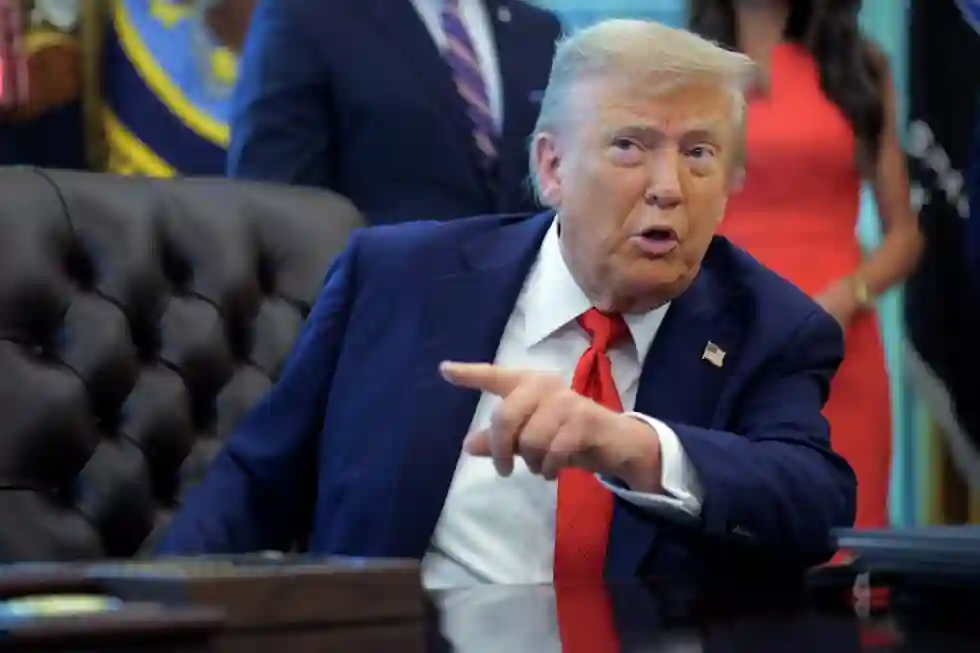
President Donald Trump has issued a bold executive order aimed at halting the proliferation of state-level AI regulations across the United States. Announced on December 14, 2025, the order directs multiple federal agencies to challenge what Trump describes as “onerous and excessive” state laws that could hinder national AI innovation and dominance. This move comes after Congress repeatedly rejected similar proposals, marking a direct intervention by the administration to establish a unified federal approach to artificial intelligence governance.
The executive order explicitly criticizes the patchwork of state AI laws, arguing they create 50 discordant standards rather than a single, minimally burdensome national framework. Trump emphasizes the need to protect America’s global AI leadership by preventing state regulations that allegedly embed ideological bias into AI models or force alterations to truthful outputs. The order targets specific measures like Colorado’s recent law requiring protections against “algorithmic discrimination” in high-risk AI systems, claiming such rules could compel developers to produce inaccurate results to avoid legal liability.
Federal Agencies Mobilized Against State Laws
Attorney General Pam Bondi receives the most direct mandate: within 30 days, she must establish an AI Litigation Task Force dedicated solely to suing states over AI laws deemed inconsistent with federal policy. These lawsuits would argue that such state measures unconstitutionally regulate interstate commerce, conflict with existing federal regulations, or violate constitutional protections. The Commerce Department is also tasked with evaluating all state AI laws to identify those that require model alterations or impose unconstitutional reporting requirements.
The order extends financial pressure tactics borrowed from earlier legislative proposals. States flagged for problematic AI laws become ineligible for significant portions of the $42 billion Broadband Equity, Access, and Deployment (BEAD) program funds—specifically the “non-deployment” allocations estimated at around $21 billion. Other federal agencies must review their discretionary grant programs and consider withholding funding from non-compliant states, creating powerful economic incentives for states to align with federal priorities.
Democratic Lawmakers Sound the Alarm
Senator Ed Markey (D-Massachusetts) immediately condemned the order as a payoff to Big Tech donors, accusing Trump of delivering on promises made to billionaire benefactors at the expense of public safety. Senator Maria Cantwell (D-Washington) warned that the broad preemption language threatens states’ ability to protect residents from AI-powered fraud, scams, and deepfakes through essential consumer safeguards. Senator Brian Schatz (D-Hawaii) called the approach “absurd and dangerous,” vowing to introduce legislation for a full repeal while insisting states must retain authority to address immediate AI harms.
Broadband Funding as Leverage
The BEAD program penalty represents particularly potent leverage, as many states rely on these federal dollars for critical broadband infrastructure beyond direct deployment subsidies. Non-deployment funds support planning, workforce training, and affordability programs—essential components of comprehensive broadband strategies. By conditioning access on AI regulatory compliance, the administration effectively weaponizes infrastructure funding to enforce its preferred light-touch AI policy nationwide.
Agency-Specific Actions and Long-Term Strategy
FCC Chairman Brendan Carr must initiate proceedings to establish federal reporting standards for AI models that would preempt conflicting state requirements. FTC Chairman Andrew Ferguson will issue guidance clarifying when state mandates to modify AI outputs violate federal prohibitions on deceptive practices. These targeted actions aim to create de facto federal preemption across multiple regulatory domains without requiring new legislation.
The order culminates in a directive for administration officials to draft comprehensive legislative recommendations for Congress. This proposed framework would establish a uniform federal AI policy preempting most state laws, with narrow exceptions for child safety protections, data center infrastructure permitting, and state government AI procurement. While congressional passage remains uncertain, the order’s immediate enforcement mechanisms could significantly deter new state AI legislation regardless of future legislative outcomes.
Colorado Law Under Fire
Colorado’s SB24-205 serves as the poster child for the administration’s concerns. The law mandates that developers of high-risk AI systems implement risk management programs, disclose decision-making processes, allow consumers to correct inaccurate personal data, and provide appeal rights for adverse automated decisions. Trump argues these requirements risk extraterritorial overreach, potentially forcing AI models to prioritize demographic outcomes over factual accuracy and impinging on interstate commerce.
Critics from groups like Americans for Responsible Innovation counter that the order relies on an overly expansive interpretation of the Commerce Clause, crafted to shield unchecked AI development from basic accountability measures. They warn that stripping states of regulatory authority creates dangerous regulatory vacuums where consumers lack protection from discriminatory or harmful AI deployments.
This executive action represents Trump’s most aggressive move yet to centralize AI policy under federal control. By combining litigation threats, funding conditions, and agency rulemaking, the administration seeks to effectively freeze state innovation in AI regulation pending congressional action—or potentially bypass it entirely. The coming months will reveal whether states push back through their own legal challenges or whether economic pressures compel widespread compliance with the federal vision for minimally regulated AI dominance.